Social Media Content Ideas for Small Businesses (Organized by Type)
How to use this list
Don't try to use every category. Pick three or four that match your goals and your audience, and rotate them. If you have defined content pillars, match each idea to a pillar. If not, these categories are a good starting point for choosing them.
For each idea, ask one question: would someone in my audience stop scrolling for this? If the honest answer is no, adapt it or skip it.
Ten types of content, with examples
1. Educational content
Why it works: it gives people a reason to follow you before they need to buy. Use it when: you want reach and trust. Examples: a 'three mistakes people make when…' carousel; a short tip answering a question customers ask in person; a before/after showing how to use your product correctly.
2. Product or service content
Why it works: people can't buy what they don't understand. Use it when: you launch something or notice people don't know what you offer. Examples: one feature explained in one post; 'who this is for and who it isn't for'; a walkthrough of what happens during your service.
3. Behind the scenes
Why it works: it makes a small business feel human and shows the effort behind the price. Use it when: engagement is flat or you want to build familiarity. Examples: packing orders on a busy day; how a product is made; the team's Monday planning.
4. Customer stories
Why it works: your customers describe your value better than you do. Use it when: you need to move people from interested to buying. Examples: a short case of a problem solved; a customer's photo with permission; a 'why they chose us' quote.
5. Social proof
Why it works: it reduces risk for new buyers. Use it when: you run an offer or launch. Examples: a review screenshot with a short comment; a milestone such as your hundredth project; a mention from a local partner.
6. Questions and engagement
Why it works: comments help reach, and replies teach you what your audience cares about. Use it when: you need ideas for future posts. Examples: 'which of these two should we make next?'; a quick poll about a common problem; asking for tips from your followers.
7. Promotional content
Why it works: clear offers convert people who are already warm. Use it when: you have something with a reason to act now. Examples: a limited booking window; a bundle for a season; an early-access list. Keep promotions to a minority of your posts so they keep working.
8. Seasonal content
Why it works: it rides on what people are already thinking about. Use it when: a season, holiday or local event fits your business. Examples: preparing for winter, back-to-school checklists, a local festival. Plan these ahead on a marketing calendar.
9. Industry insights
Why it works: it positions you as the person who knows the field. Use it when: you sell to businesses or to informed buyers. Examples: what a new rule means for your customers; a trend you see in your own work; your honest take on a common piece of advice.
10. Repurposed content
Why it works: your best ideas deserve more than one post. Use it when: you are short on time. Examples: turn a newsletter into a carousel; a customer FAQ into a short video; a top post from last year into an updated version. See how to repurpose content across social media.
Example: one week of ideas for a local fitness studio
| Day | Type | Idea | Platform |
|---|---|---|---|
| Mon | Educational | Three warm-up mistakes that cause sore knees | Instagram, Facebook |
| Tue | Behind the scenes | How the coaches plan next month's classes | |
| Wed | Customer story | Member who returned to running after six months | Facebook, LinkedIn |
| Thu | Engagement | Poll: morning or evening classes? | |
| Fri | Promotional | Two free trial spots for next week | Instagram, Facebook |
Notice that only one post out of five is a direct offer. The others build the trust that makes the offer work.
Turn ideas into a posting plan
Ideas are only useful once they move through a workflow: ideas, then planning, creation, adaptation, approval and scheduling.
- 1
Capture ideas in one backlog
One list, not notes spread across apps. Tag each idea with its type or pillar. Our tutorial on organizing marketing content shows how. - 2
Pick ideas for the next period
Choose a balanced mix of types for the week or month, then place them on a calendar. A social media content calendar template helps. - 3
Create in batches
Write and design several posts in one session. See how to batch social media content. - 4
Adapt, approve and schedule
Adjust each post for its channel, get sign-off if needed, then schedule it.
Common mistakes with content ideas
- Copying trends that don't fit. A trend only helps if it connects to what you sell or know.
- Only posting offers. Promotions work better when most posts give value first.
- Losing good ideas. Ideas you don't write down are gone by the next planning session.
- Using every idea everywhere. Some ideas suit Instagram, others LinkedIn. Choose channels per idea.
How Wemify can help
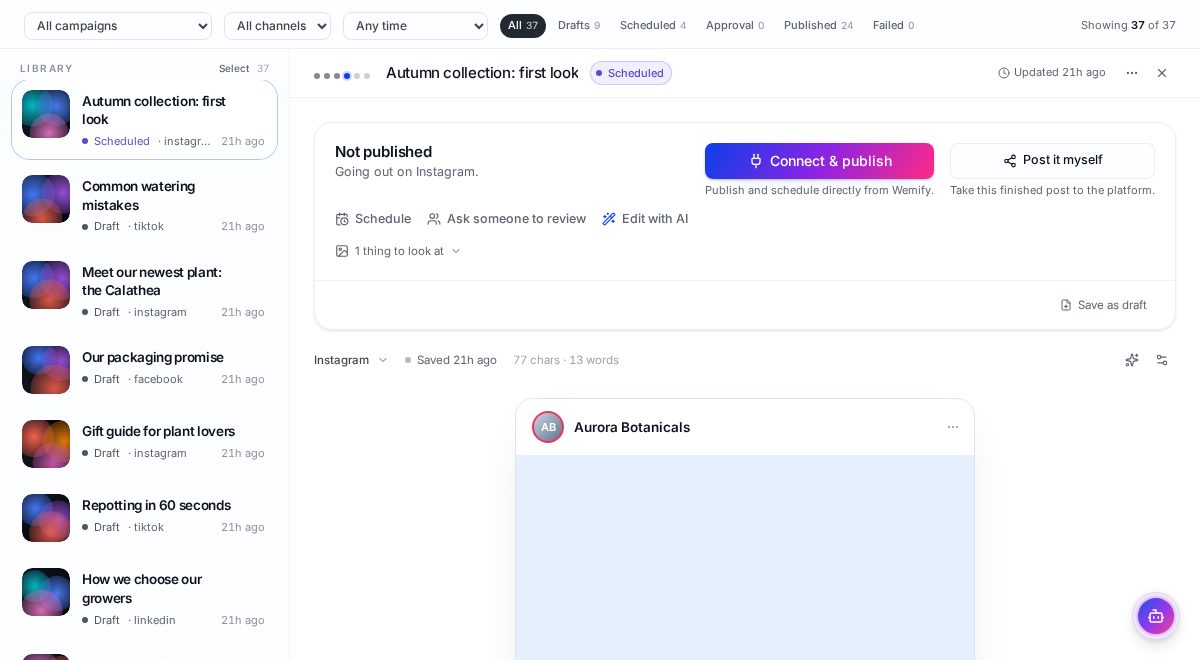
In Wemify, ideas become drafts you can group into campaigns, adapt for each connected channel, send for review and schedule. The Posts library shows every idea's status, so nothing gets lost between idea and published post.
If you want a tool to keep this workflow in one place, see how Wemify works as content workflow software. For the bigger picture, read our guide to building a social media content strategy.
Frequently asked questions
What should a small business post on social media?
A mix of educational posts, behind the scenes, customer stories and occasional offers usually works better than only promotions. Pick three or four content types and rotate them.
How many content ideas do I need per month?
Collect more ideas than you have slots, roughly one and a half times as many, so you can drop the weaker ones.
How do I come up with new ideas when I run out?
Look at customer questions, comments, reviews, your own recent work and posts that did well before. Repurposing older content is also a reliable source.
How often should a small business post promotional content?
There is no fixed rule, but keeping offers to a minority of your posts helps them stand out when they appear.
Turn your ideas into scheduled posts
Capture ideas, write drafts and move them to the calendar in one workspace.
Continue reading
How to Create Content Pillars for Social Media
A practical method for choosing social media content pillars from your business goals, with examples for three industries and how to turn pillars into posts.
ReadHow to Batch Social Media Content: A Practical Workflow
Content batching explained for small teams: group ideas, writing, adapting, approvals and scheduling into focused sessions, with an example batching week and checklist.
ReadSocial Media Content Strategy for Small Businesses
Build a small business social media content strategy in 13 practical steps, from goals and platforms to pillars, calendar, batching, approvals and measuring results.
Read